
Blog
CVE-2025-65018 Advisory: Root Delivers Minutes-Level Patching at Scale Across All Debian Variants
CVE-2025-65018 – a heap buffer overflow in libpng – hit on November 24, 2025. CVSS scores up to 9.8. libpng ships by default in Debian Bullseye, Bookworm, and Trixie, meaning millions of container images pulled daily carry this vulnerability until patched.

Root team
The Root team
Published :
Nov 25, 2025
Another day, another critical CVE.
On November 24, 2025, the security world got hit with CVE-2025-65018 – a heap buffer overflow in libpng that could lead to arbitrary code execution. CVSS scores ranging from 7.1 to 9.8. The kind of vulnerability that makes AppSec teams scramble and engineering teams groan.
But here's what makes this one different: libpng isn't just another library. It's the official reference implementation for PNG image processing, embedded in virtually every application that touches PNG files. After 30+ years in production, libpng is everywhere – web browsers (Chrome, Firefox, Safari), image editors (Photoshop, GIMP, Illustrator), game engines, scientific tools, data visualization platforms, and countless Linux distributions.
On Debian alone – one of the most popular base images for containerized applications – libpng ships by default in Bullseye, Bookworm, and Trixie, meaning every Docker image built on these releases carries this vulnerability until patched. With millions of Debian-based container images pulled daily from registries worldwide, the blast radius isn't just large – it's global.
Here's the thing: while everyone else was still reading advisories and figuring out their patch strategy, Root's platform had already researched, patched, tested, and delivered fixes for Bullseye, Bookworm, and Trixie – all three Debian releases affected by this vulnerability.
Timeline as of November 25, 2025
Date & Time | Root Action | Description |
Nov 24, 2025 – 15:00 UTC | Security Advisories Published | Security advisories for CVE-2025-65018 begin publishing across Linux distributions. |
Nov 25, 2025 – 15:03 UTC | Root AI Detection | Root AI agents automatically detect the CVE within 3 minutes, collect all upstream intelligence (CVE record, GitHub advisory, Debian tracker, upstream commits, community patches). |
Nov 25, 2025 – 15:12 UTC | Root Research Completion | Root determines vulnerability location, confirms affected Debian versions (Bullseye, Bookworm, Trixie), analyzes libpng 1.6.51 upstream fix, and generates backport strategy. |
Nov 25, 2025 – 15:18 UTC | Root Applies Patches Automatically | Root's agentic patching engine backports and applies fixes to all affected releases in parallel: Bullseye (1.6.37-3), Bookworm (1.6.39-2), Trixie (1.6.48-1). |
Nov 25, 2025 – 15:35 UTC | Root Testing Complete | Root completes package tests, functional tests, CVE-specific tests, integration tests, and ABI compatibility verification—ensuring fully validated patch sets for all releases. |
Nov 25, 2025 – 15:42 UTC | Patched Images Delivered to Customers | Root publishes fully tested, production-ready, fixed images to customer pipelines via the Root platform with full transparency and traceability. |
42 minutes from advisory to production-ready patches across three Debian releases.
No tickets. No triage meetings. No "hey engineering, can you drop everything and patch this?"
Just done.
What is CVE-2025-65018?
Let's cut through the noise. libpng is everywhere – it's the library that processes PNG images. Your image viewers use it. Your web browsers use it. Your game engines use it. If something displays or processes PNGs, it's probably using libpng.
The vulnerability lives in png_image_finish_read, a function in libpng's simplified API. When processing 16-bit interlaced PNG images with an 8-bit output format, the function doesn't properly check buffer bounds. An attacker crafts a malicious PNG, and boom – heap buffer overflow. Memory corruption. Potential code execution.
Affected versions: libpng 1.6.0 through 1.6.50
Fixed version: libpng 1.6.51
For Debian users, that meant:
Bullseye: 1.6.37-3 (vulnerable)
Bookworm: 1.6.39-2 (vulnerable)
Trixie: 1.6.48-1 (vulnerable)
The fix exists in Debian unstable (sid) at 1.6.51-1, but good luck getting that into production without breaking something or waiting weeks for backports.
The Old Way: Shift Left's Epic Failure
When a critical CVE drops, traditional security workflows kick off a predictable spiral: days of triage meetings, weeks of engineering scramble, and an ever-growing exposure window while attackers weaponize the vulnerability within hours. Engineering burns 20% of their time on CVE janitor duty. AppSec waits, accountable for risks they can't actually fix. The result? Weeks of exposure—while Root customers were patched in 42 minutes.
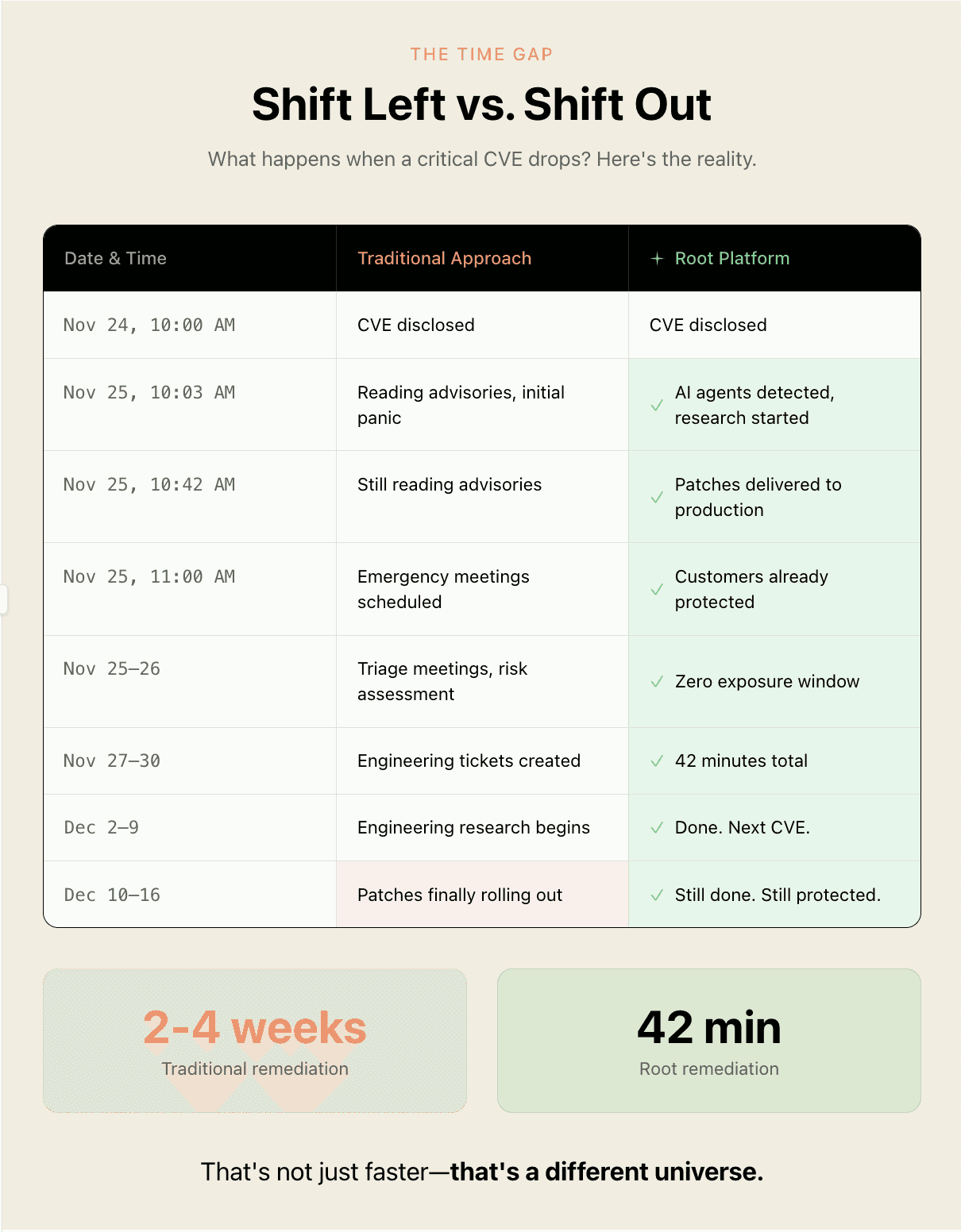
CVE response timeline comparison: Traditional shift-left workflows vs. Root's automated remediation platform.
The Technical Details
Our agents backported the fix from libpng 1.6.51 to each Debian release, tracing the specific upstream commits and ensuring compatibility across configurations.
The patched images are live now—pull the latest at cr.root.io, or sign up at app.root.io to access your specific tagged versions.
Can’t believe it? See for yourself in our Package Explorer:
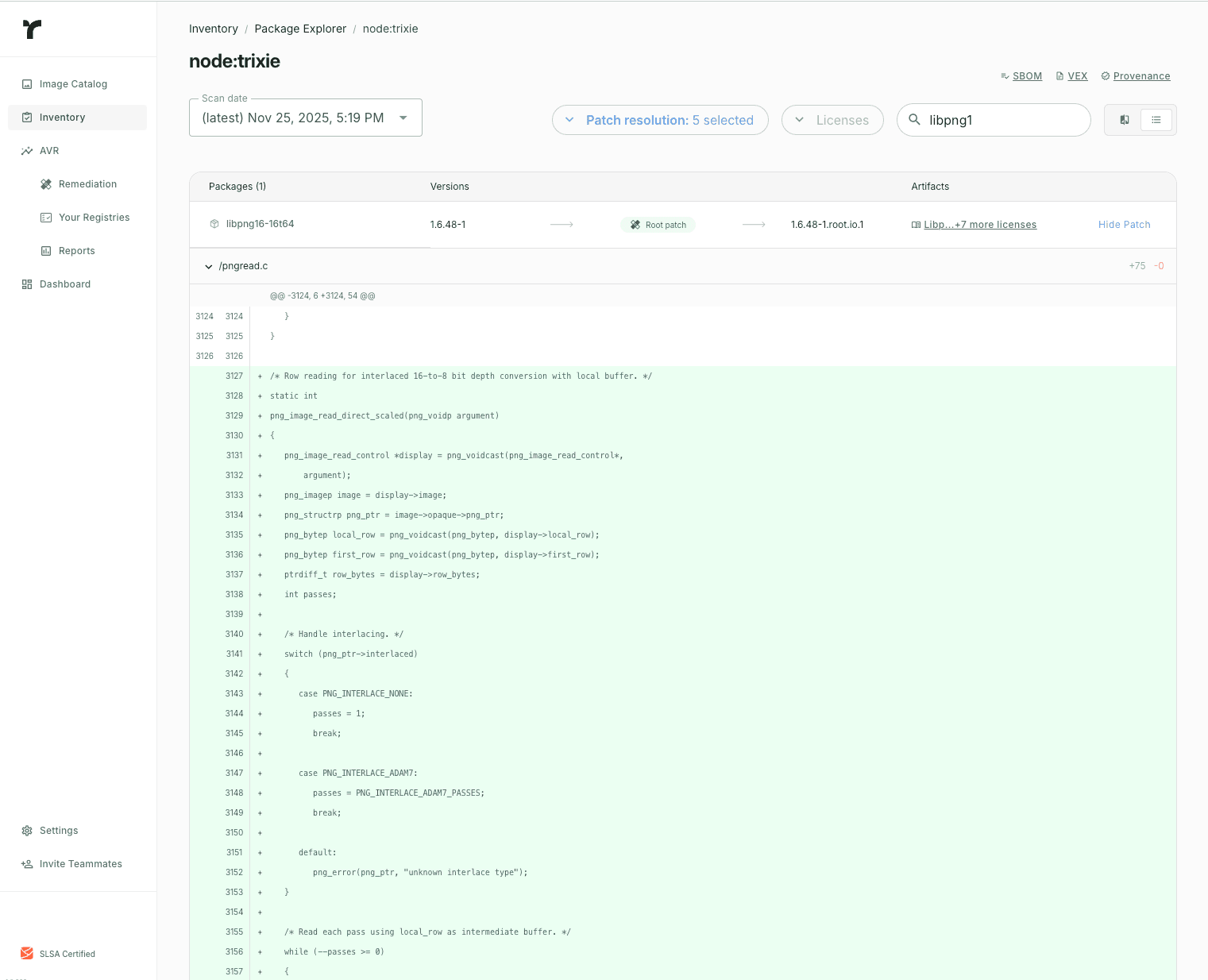
Root's Package Explorer showing patched libpng versions across Debian releases
Why This Matters: Matching Attackers at AI Speed
As Bo Berlas put it: "We need to be able to match the speed and agility at which cyber actors weaponize vulnerabilities. It really comes down to the very simple point of the time to patch, and the availability of patch does not effectively commensurate with the time to exploit."
Attackers armed with AI can weaponize CVEs the same day they're published – sometimes within hours. The old model leaves you playing whack-a-mole at human speed (weeks) against threats at AI speed (hours).
42 minutes vs. 2-4 weeks. That's the difference between staying ahead of attackers and playing catch-up.
Root's platform moves at AI speed because it's powered by AI. Thousands of specialized agents working in parallel, researching, patching, and testing simultaneously across all affected releases. No human bottlenecks. No coordination delays.
This isn't just about one CVE. It's about the fundamental shift in software supply chain security. The old model: AppSec owns the problem, Engineering owns the solution. Everyone waits. Everyone loses.
The new model: Open source arrives clean. Vulnerabilities are fixed automatically in minutes. Engineering stays focused on building. AppSec leads remediation without depending on anyone.
That's Shift Out. And unlike "hardened image" approaches that force you to refactor and lock you into vendor ecosystems, Root doesn't change your workflow. You use your version. Your stack. Your base images. We just make them secure.
If you're still playing whack-a-mole with CVEs at human speed while attackers move at AI speed, it's time to Shift Out.
Sign up for Root Image Catalog or talk to a human to see how Root can transform your security posture.
References:
Continue Reading