

Blog
Why AI-Driven Development Demands AI-Speed Security
If you're scaling development with AI, you should also be scaling your security debt with AI.

Root team
The Root team
Published :
Mar 6, 2026


In our previous post, we dove into how the AI coding revolution changed the game overnight. We spoke about what LLM-driven development looks like in practice, and how tools like Claude Code, Cursor, and GitHub Copilot turned every developer into a 10x engineer. Teams ship features faster, prototypes become production apps in days, and code generation is now table stakes.
But while we rejoice and celebrate the speed of development that’s now possible thanks to AI, there is a problem nobody's talking about - if you're scaling development with AI, you should also be scaling your security debt with AI.
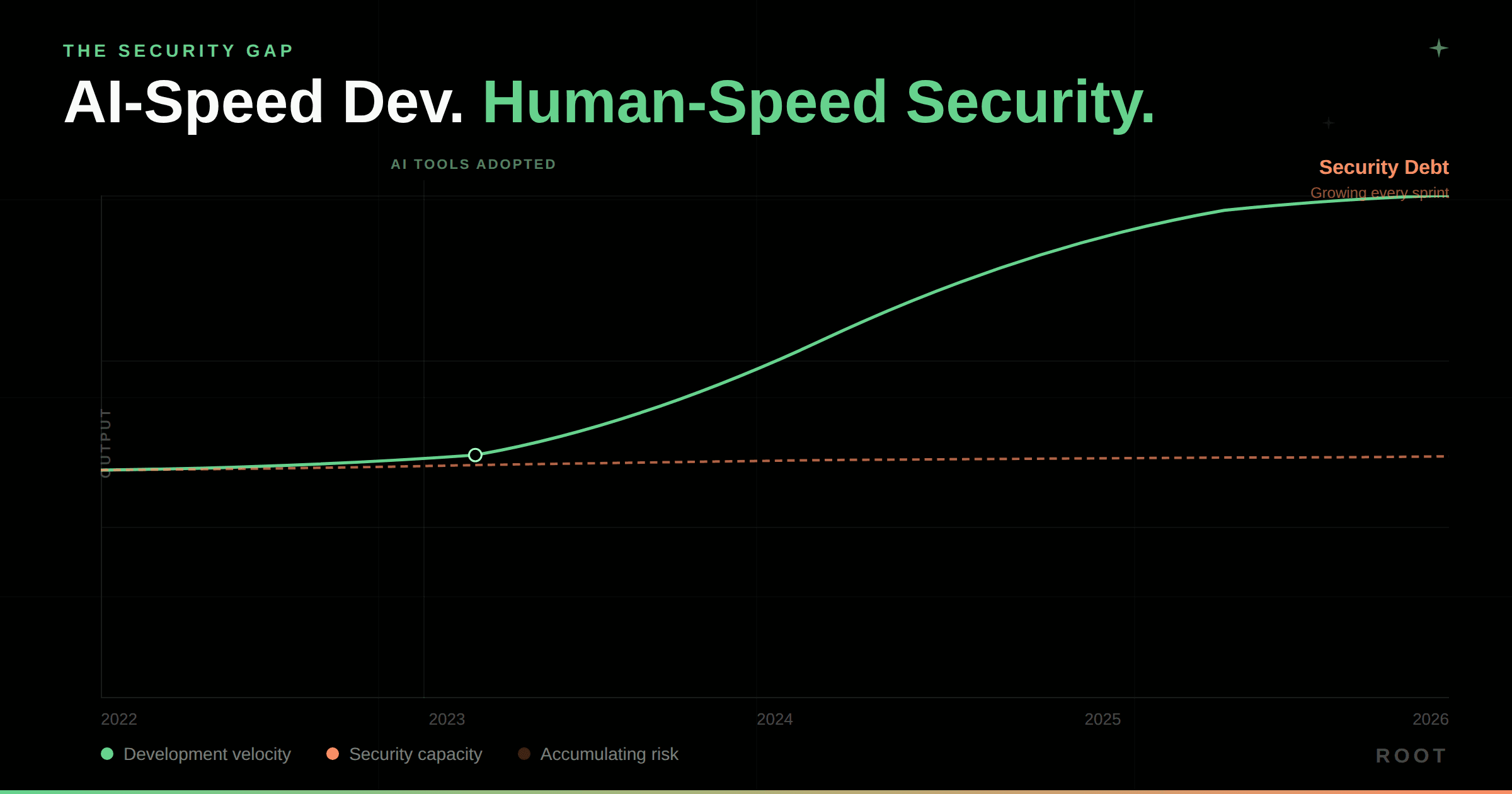
Before AI coding tools, developer output and security capacity were roughly matched. Now developers ship 10x more code while security teams have largely remained the same size - and the gap is only compounding with every sprint.
Manual Security Can't Keep Pace with AI-Accelerated Development
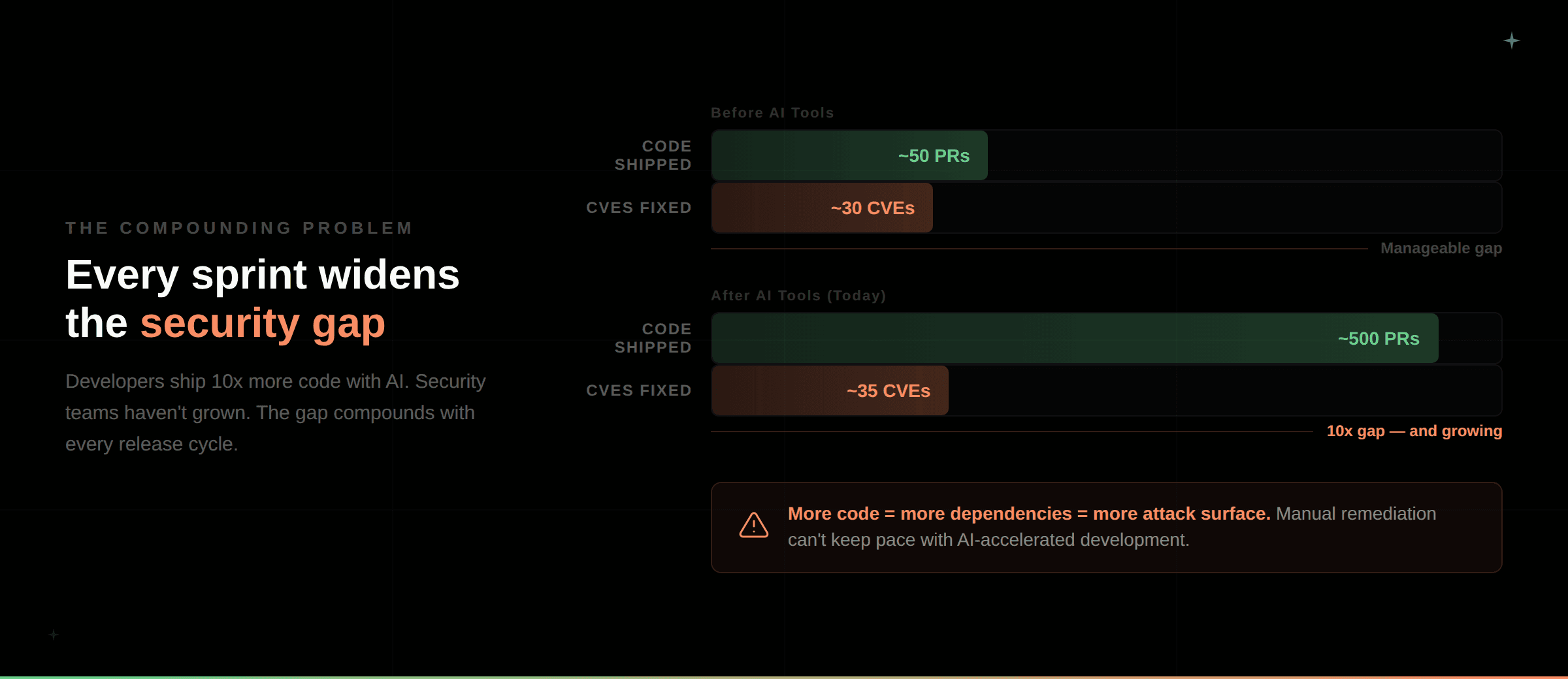
Traditional vulnerability remediation is a human-speed process. A security engineer reviews a CVE, researches the fix, identifies affected systems, crafts a patch, tests it, and deploys. This takes hours or days per vulnerability. Scale that across hundreds or thousands of CVEs, and you're perpetually behind.
Meanwhile, your developers are using AI to ship faster than ever. The productivity gains from Cursor and Claude Code are real, but they come with a cost: more code means more dependencies, more attack surface, and more vulnerabilities to remediate.
You simply can't continue to secure AI-speed development with human-speed security.
If your developers use AI to build, your security team needs AI to defend. Not as a nice-to-have productivity boost, but as the only way to keep pace.
This is what we mean by "scale securely." You don't get to choose between speed and security anymore. You need both, and the only way to achieve both is through AI-native security that operates at the same speed as AI-native development.
What AI-Native Security Actually Means
AI-native security isn't just "using AI for security tasks." It's rebuilding the entire remediation process around AI capabilities, the same way AI coding tools rebuilt development workflows.
In our previous post we detailed what fundamentally changed in development processes with the adoption of Cursor & Claude Code. Developers didn't just type faster. The entire development process underwent (and is still undergoing) a transformation - from ideation to implementation to testing. AI became the substrate, not the assistant.
Security needs the same fundamental transformation. Not AI as a productivity boost for the existing process, but AI as the foundation of an entirely new process.
Here's what we envision this actually means:
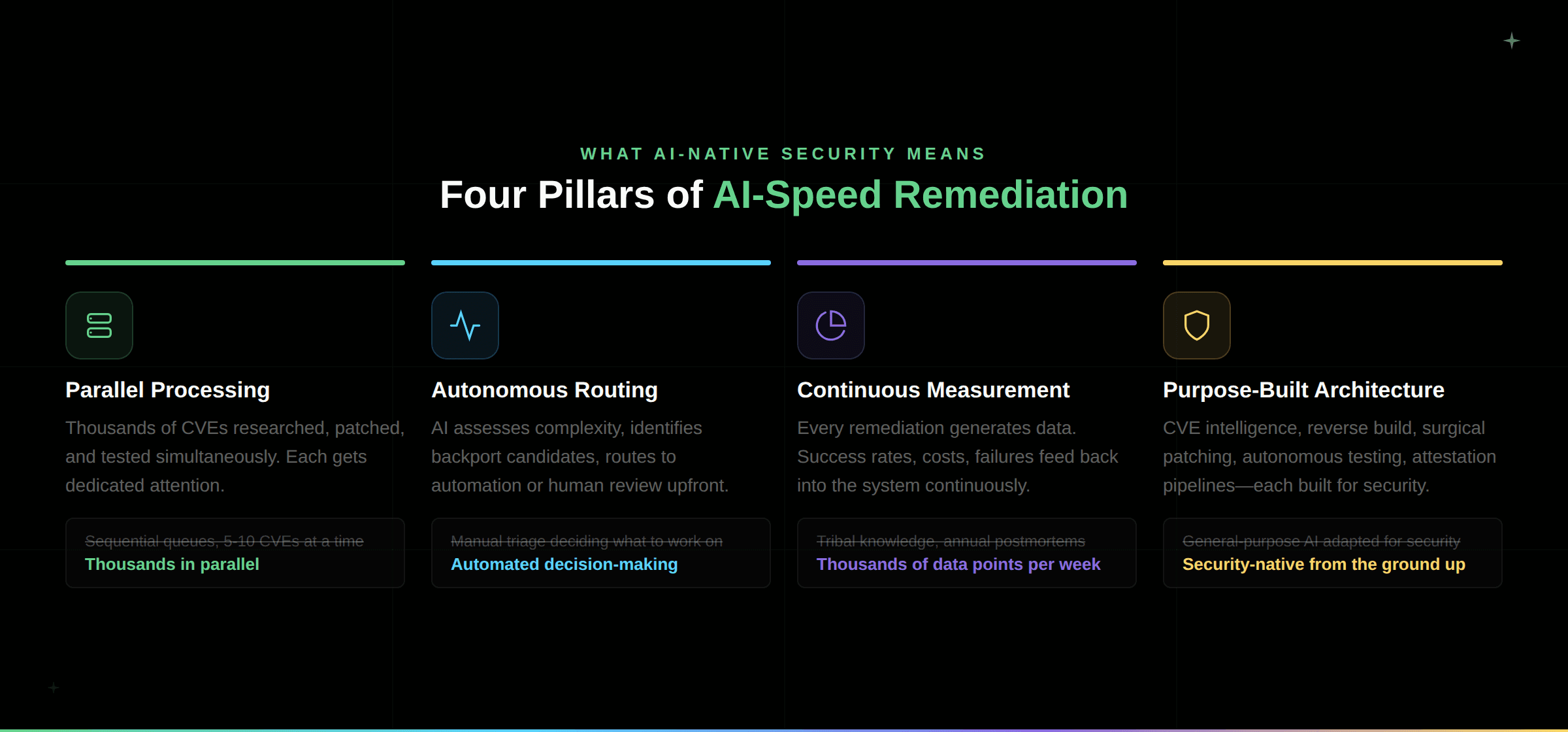
Parallel processing replaces sequential queues. Human security teams work serially. They triage a CVE, research it, craft a fix, test it, deploy it. Then move to the next one. Even the best teams handle maybe 5-10 CVEs concurrently. AI doesn't have this constraint. Thousands of vulnerabilities can be researched, patched, and tested simultaneously. Each gets dedicated attention without waiting for the previous one to finish. The bottleneck shifts from human bandwidth to compute capacity.
Autonomous routing replaces manual triage. Traditional security teams spend significant time just deciding what to work on and how. Which CVEs are critical? Which have available patches? Which require custom fixes? AI assesses this upfront. It evaluates complexity, identifies backport candidates, determines whether a fix can be automated or needs human expertise, and routes accordingly. The decision-making itself is automated, not just the execution.
Continuous measurement replaces tribal knowledge. Human teams improve through experience and postmortems. AI systems improve through measurement at scale. Every remediation generates data: success rates, costs, escalation patterns, test failures. This data feeds back into the system continuously. Underperforming agents get refined. Inefficient routing gets adjusted. The system learns from thousands of remediations per week, not dozens per year.
Purpose-built architecture replaces adapted tools. General-purpose AI tools like Claude Code are powerful, but they're designed for general coding tasks. AI-native security requires purpose-built systems: CVE intelligence gathering oriented toward fix-finding, reverse build capabilities to understand how binaries were created, surgical patching logic that minimizes change surface, autonomous testing frameworks that verify fixes without human oversight, attestation pipelines that generate proof chains (SLSA, SBOM, VEX). Each component exists for one reason: secure, verified vulnerability remediation at scale.
Welcoming a New Reality for Security
The AI revolution democratized fast development. Security debt is now growing faster than any human team can address it.
Organizations that embrace AI-accelerated development without AI-accelerated security are building on a foundation of accumulating risk. Every sprint widens the gap between code shipped and vulnerabilities remediated.
The companies that will thrive in this new era are those that recognize a fundamental truth. If you scale with AI, you must secure with AI. There's no other way to keep pace.
Your developers are already using Cursor. Your security team needs to match their speed.
At Root, we've been hard at work reimagining what AI security at the pace of AI development should look like. We've built a system that operates on the same principles as the AI development tools your teams already use, parallel processing, autonomous decision-making, continuous measurement, and purpose-built architecture. In our next posts, we'll take you under the hood to show you exactly how it works, and we intentionally baked in reliability to ensure engineers can trust the machines.
Continue Reading