

Blog
Industrialized Software Supply Chain Security: Why AI Assistants Cannot Replace Systemic Control

John Amaral
CTO, Co-Founder
Published :
Feb 25, 2026

AI-powered code analysis is advancing rapidly. Large language models can now reason about complex repositories, identify subtle vulnerabilities, and generate plausible patches. They reduce cognitive load. They accelerate review cycles. They surface issues that traditional static tools sometimes miss.
That progress is meaningful.
But it is also prompting a flawed conclusion: that sufficiently intelligent AI assistants can replace the need for systemic supply chain security infrastructure.
They cannot.
The reason is structural.
The Category Error: Assistant vs System
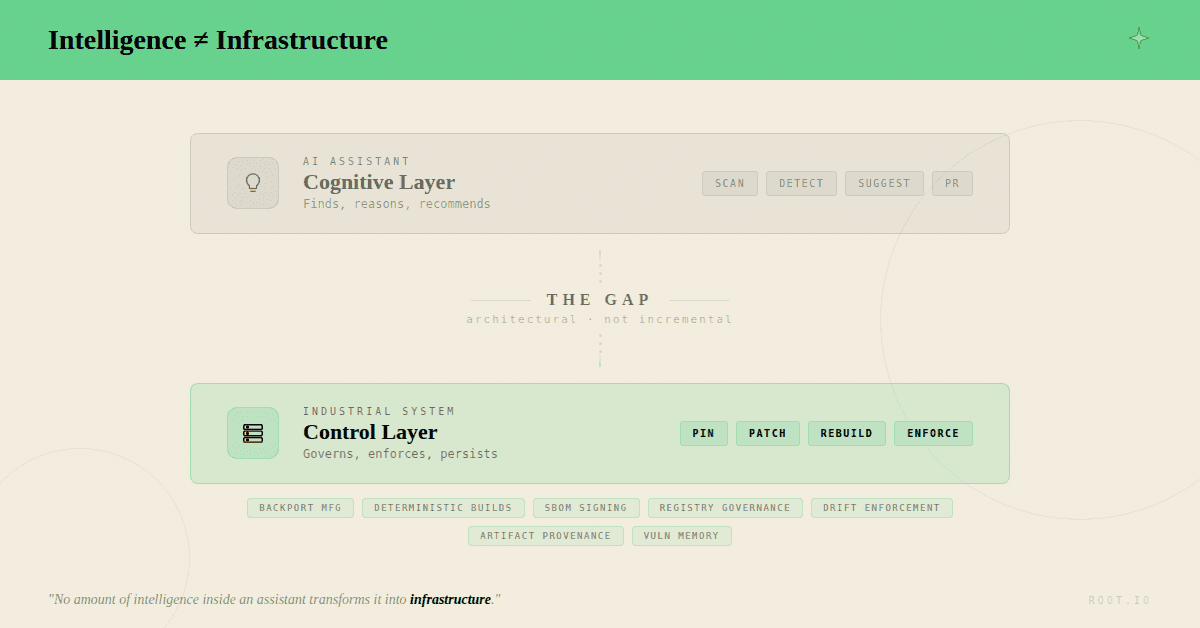
AI code analysis tools are assistants.
They are invoked by developers. They inspect a repository. They produce findings and recommendations. They may open pull requests. Then they stop.
Industrialized supply chain security is a system.
It operates continuously. It governs artifact production and distribution. It enforces dependency pinning. It rebuilds artifacts deterministically. It applies backported patches. It regenerates signed SBOMs. It controls what enters production environments. It prevents drift across thousands of dependencies and ecosystems.
An assistant improves decision-making inside a codebase.
A system governs how software is manufactured and trusted at scale.
These are not interchangeable layers.
No amount of intelligence inside an assistant transforms it into infrastructure.
The Real Problem Is Propagation
Modern supply chain attacks succeed not because vulnerabilities are undetected, but because risk propagates.
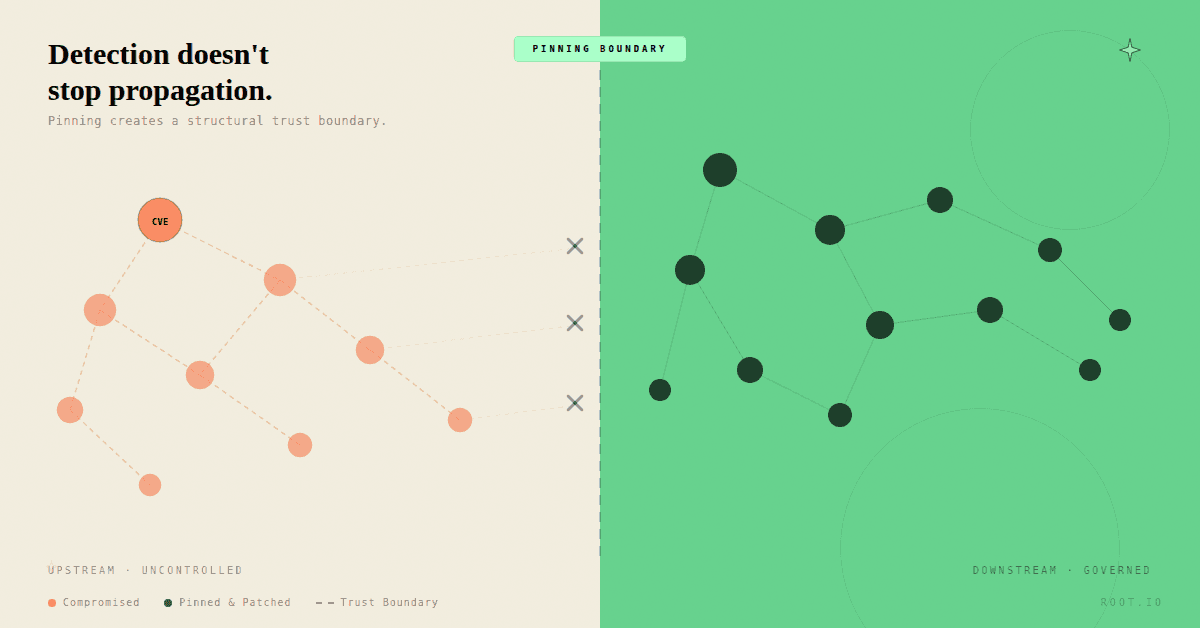
They exploit mutable upstream artifacts. They rely on unpinned dependencies and automatic version ingestion. They depend on transitive drift and implicit registry trust. They assume that when upstream changes, downstream systems will absorb that change automatically.
If the upstream artifact is compromised, the compromise spreads.
Whether the vector is dependency confusion, malicious package injection, tag mutation, or registry poisoning, the underlying mechanic is the same: propagation.
Improving detection does not eliminate propagation.
Preventing propagation requires structural control.
Pinning as a Security Boundary
Strict dependency pinning is not a hygiene practice. It is a trust boundary.
When dependencies are pinned, upstream mutations do not auto-ingest. Mutable tags lose their power. Transitive auto-upgrades are eliminated. Builds become deterministic.
Pinning collapses a large class of supply chain attack vectors before they spread.
But pinning introduces tension. If everything is frozen, how do you remediate vulnerabilities without destabilizing the graph?
Traditional remediation often defaults to upgrades. At ecosystem scale, constant upgrades create ABI risk, cascading dependency failures, operational churn, and unpredictable runtime changes.
Pinning without a sustainable remediation model becomes brittle.
This is where backported patches matter.
Backported Patches Make Stability Possible
Backporting allows security fixes to be surgically applied to pinned versions without forcing version mutation.
The dependency graph remains stable. Deterministic builds are preserved. Transitive relationships remain intact. Security fixes are applied without triggering cascade effects.
Pinning prevents propagation.
Backporting makes pinning viable at scale.
Together, they create a structural defense model that does not depend on reacting to every new malware variant individually. Instead, they generically eliminate the propagation mechanism those attacks rely on.
This is not a feature.
It is infrastructure.
Industrialization Is More Than Automation
A common counterargument is simple: automate AI tools in CI/CD and you achieve systemic remediation.
That view mistakes workflow automation for industrialization.
Running a model in CI can continuously scan code. It can open remediation pull requests. It can recommend version upgrades. It can even generate patches.
It cannot:
Maintain persistent cross-ecosystem vulnerability intelligence.
Coordinate backported patch manufacturing across thousands of packages.
Operate deterministic rebuild farms at scale.
Guarantee multi-architecture artifact parity.
Regenerate and sign SBOMs for distributed artifacts.
Replace upstream artifacts at registry scale.
Enforce pinned-first governance across organizations.
Prevent transitive drift outside the repository boundary.
CI automation orchestrates analysis.
Industrialization governs production.
The difference is structural and capital-intensive.
Why Diffused AI Use Cannot Secure the OSS Universe
Another optimistic view is that if maintainers adopt AI tools broadly, open-source security will improve organically.
Open source is massively decentralized. Maintainers have limited time, uneven incentives, and varying levels of security expertise. Tool adoption is inconsistent. Coordination is voluntary. Enforcement is nonexistent.
Even universal adoption of AI assistants would not create:
Global pinning enforcement.
Cross-ecosystem vulnerability memory.
Coordinated backport strategies.
Deterministic artifact publishing.
Registry-level governance.
Point tools improve local code quality.
Systemic risk requires systemic control.
Without infrastructure, risk re-enters through drift, transitive ingestion, and inconsistent remediation.
Why Enterprises Cannot Economically Replicate Industrialization
Enterprises could, in theory, build their own industrialized supply chain systems.
In practice, it is prohibitively expensive.
Industrialization requires:
Dedicated backport engineering capability.
Continuous deterministic rebuild infrastructure.
Cross-ecosystem vulnerability intelligence.
Artifact signing and provenance systems.
Drift enforcement across CI/CD.
Registry-scale publishing and artifact replacement.
Persistent regression tracking and operational memory.
This resembles operating a secure distribution ecosystem, not deploying a development tool.
Most enterprises are consumers of open source, not manufacturers of ecosystem-wide trust infrastructure.
Industrialization becomes economically viable only when it operates at shared scale.
Why Model Vendors Are Unlikely to Industrialize This Layer
Even as AI systems grow more capable, industrializing supply chain security remains a distinct business model.
Model vendors are optimized for model advancement, inference scale, and horizontal adoption. Their economic engine is tied to cognitive capability and API usage.
Industrialized artifact governance is operationally heavy. It requires sustained ecosystem expertise, compliance rigor, patch discipline, deterministic build systems, and long-term maintenance commitments.
It resembles infrastructure stewardship rather than model research.
AI can enhance industrial systems.
But industrialization is not a natural extension of inference APIs.
Cognition Versus Control
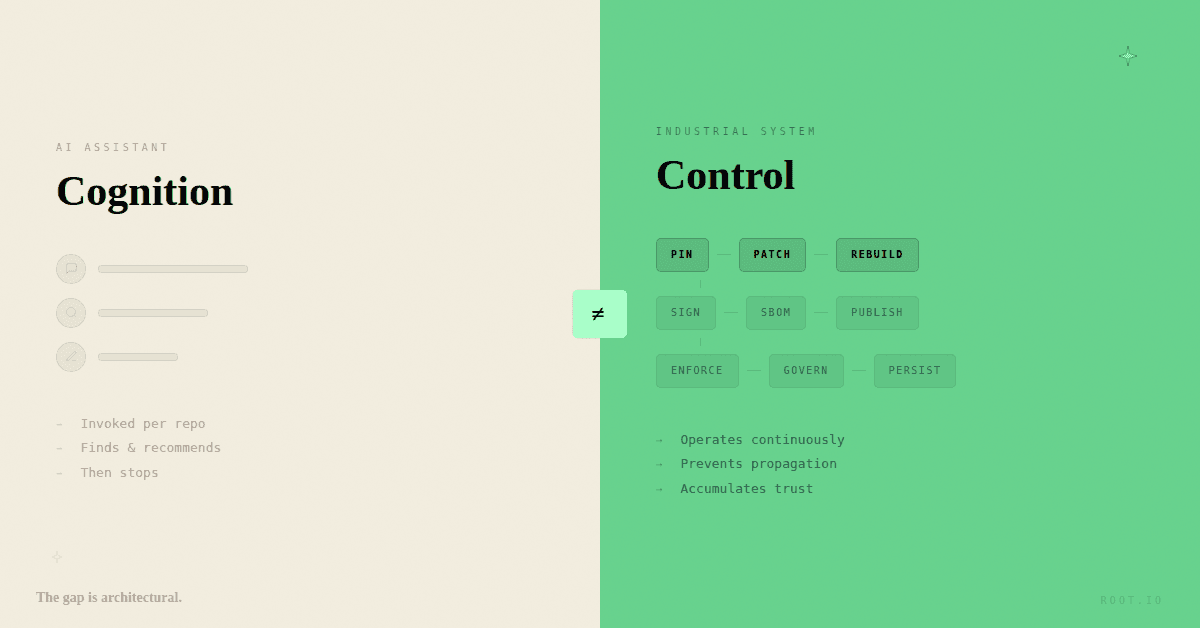
This debate ultimately reduces to a choice between cognition and control.
AI assistants enhance cognition. They help developers understand risk more quickly and accurately.
Industrialized supply chain systems enforce control. They determine what artifacts are trusted. They freeze dependency graphs. They eliminate drift. They prevent propagation. They accumulate trust over time.
Reasoning improves awareness.
Control establishes trust boundaries.
You cannot reason your way out of propagation without governing the artifact lifecycle.
The Durable Distinction
As AI agents improve, cognitive advantage will compress. Models will reason better. Suggestions will become more accurate. Code analysis will become faster.
But industrialization compounds operational advantage.
Persistent vulnerability memory, deterministic rebuild pipelines, backported patch capability, registry-scale governance, and ecosystem-wide enforcement grow stronger over time. They accumulate operational knowledge and trust.
The gap between an assistant and a system is not incremental.
It is architectural.
Industrialized Software Supply Chain Security is not about smarter scanning.
It is about continuously building trust at an open-source scale.
Detection will continue to evolve.
Propagation prevention still requires infrastructure.
And infrastructure, not assistants, is what secures the software supply chain.
Continue Reading