

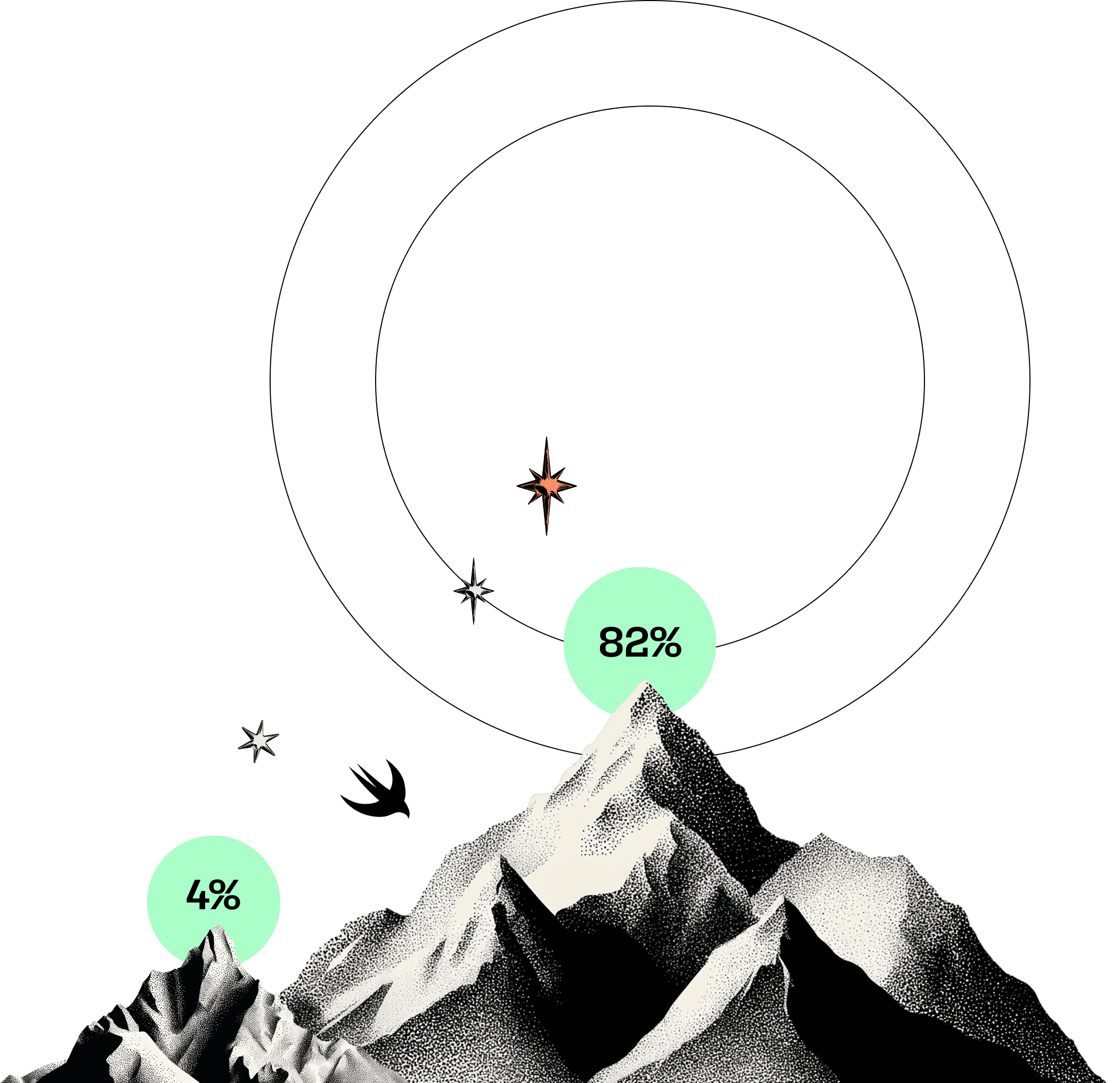
The Shift-Left Lie: Why 82% Claim Success While Only 4% Achieve It
The Shift-Left Lie: Why 82% Claim Success While Only 4% Achieve It
New research reveals a 78-point gap between perception and reality in vulnerability remediation
New research reveals a 78-point gap between perception and reality in vulnerability remediation

The Evidence Is Overwhelming

Show signs of CVE-related burnout, with 47% reporting slower incident response times
88%
Per team per month spent on remediation—costing $2.7M-$3.3M annually for a 100-person engineering org
1.31 FTEs
Routinely defer fixes due to breaking changes, even when vulnerabilities have known patches
66%
Experienced multiple release delays due to security findings in the past year
60%
Want to continue developer-owned remediation. The rest want automation to handle it.
Only 12%
What's Inside the Report
What's Inside the Report
We surveyed 160 senior cybersecurity decision-makers to answer one question: Is shift-left security actually working?
The answer reveals both a crisis and an opportunity. Organizations face a fundamental disconnect between perception and reality in vulnerability remediation—but emerging autonomous remediation technology can finally close the gap.
We surveyed 160 senior cybersecurity decision-makers to answer one question: Is shift-left security actually working?
The answer reveals both a crisis and an opportunity. Organizations face a fundamental disconnect between perception and reality in vulnerability remediation—but emerging autonomous remediation technology can finally close the gap.

The Perception Gap:
Why 82% believe shift-left works while only 4% achieve zero CVE debt
The Fundamental Problem:
How detection scaled with automation while remediation stayed manual
The Path Forward:
How autonomous remediation agents scale with compute, not headcount
Six Symptoms of a Broken Model:
From accumulating debt to team burnout to structural challenges
What Organizations Actually Want:
Only 12% prefer the status quo; 56% are ready to adopt automation
Executive Recommendations:
Specific actions for CISOs, VPs of Engineering, and DevOps leaders
The Perception Gap:
Why 82% believe shift-left works while only 4% achieve zero CVE debt
Six Symptoms of a Broken Model:
From accumulating debt to team burnout to structural challenges
The Fundamental Problem:
How detection scaled with automation while remediation stayed manual
What Organizations Actually Want:
Only 12% prefer the status quo; 56% are ready to adopt automation
The Path Forward:
How autonomous remediation agents scale with compute, not headcount
Executive Recommendations:
Specific actions for CISOs, VPs of Engineering, and DevOps leaders
The Perception Gap:
Why 82% believe shift-left works while only 4% achieve zero CVE debt
Six Symptoms of a Broken Model:
From accumulating debt to team burnout to structural challenges
The Fundamental Problem:
How detection scaled with automation while remediation stayed manual
What Organizations Actually Want:
Only 12% prefer the status quo; 56% are ready to adopt automation
The Path Forward:
How autonomous remediation agents scale with compute, not headcount
Executive Recommendations:
Specific actions for CISOs, VPs of Engineering, and DevOps leaders

"Detection scaled with automation. Remediation stayed manual, scaling only with headcount. Organizations detect thousands of vulnerabilities monthly but can fix only dozens. This capacity mismatch has become a critical business risk."

How the 4% Solved This Problem
Our research found that only 4% of organizations have achieved zero CVE debt—and they didn't get there by asking developers to work harder. They automated remediation out of the developer workflow entirely.
Root delivers the autonomous remediation platform that makes this possible.


Root Addresses the Top Pain Points From Our Survey:

For the 66% deferring fixes due to breaking changes:
Root fixes vulnerabilities at your current, pinned versions—no forced upgrades, no migration, no breaking changes. While other vendors force you to upgrade (risking supply chain attacks like the Shai-Hulud incident documented in our report), Root backports the smallest safe fix to where you are today.
For the 66% deferring fixes due to breaking changes:
Root fixes vulnerabilities at your current, pinned versions—no forced upgrades, no migration, no breaking changes. While other vendors force you to upgrade (risking supply chain attacks like the Shai-Hulud incident documented in our report), Root backports the smallest safe fix to where you are today.
Instant security: Adopt a secure foundation without changing your stack.

For the 63% who say application dependencies are their #1 pain point:
Root secures what actually hurts: npm, pip, maven, gradle dependencies and transitive chains. While the industry obsesses over base images, Root automates the layer everyone else ignores.
For the 63% who say application dependencies are their #1 pain point:
Root secures what actually hurts: npm, pip, maven, gradle dependencies and transitive chains. While the industry obsesses over base images, Root automates the layer everyone else ignores.
Instant security: Adopt a secure foundation without changing your stack.

For the 88% experiencing burnout and teams spending 1.31 FTEs monthly:
Root's AI agents handle detection, patching, testing, and validation automatically. Remove developers from the critical path entirely. Reclaim $2.7M-$3.3M annually per 100 engineers and redirect that capacity to building product.
For the 88% experiencing burnout and teams spending 1.31 FTEs monthly:
Root's AI agents handle detection, patching, testing, and validation automatically. Remove developers from the critical path entirely. Reclaim $2.7M-$3.3M annually per 100 engineers and redirect that capacity to building product.
Instant security: Adopt a secure foundation without changing your stack.
The Platform:

Root Image Catalog (RIC):
2,000+ pre-hardened containers across 40+ languages, drop-in ready for your existing pipeline
Root Image Catalog (RIC):
2,000+ pre-hardened containers across 40+ languages, drop-in ready for your existing pipeline
Root Library Catalog (RLC):
Continuous dependency remediation across 8+ languages at your pinned versions—no breaking changes
Root Library Catalog (RLC):
Continuous dependency remediation across 8+ languages at your pinned versions—no breaking changes
SLA-backed remediation:
7-30 day fixes depending on severity and tier
SLA-backed remediation:
7-30 day fixes depending on severity and tier
Zero developer toil:
Autonomous remediation that scales with compute, not headcount
Zero developer toil:
Autonomous remediation that scales with compute, not headcount
The Result:
Join the 4% achieving zero CVE debt while keeping engineers focused on product.
The Result:
Join the 4% achieving zero CVE debt while keeping engineers focused on product.
Three Critical Insights
Three Critical Insights

The Developer Capability Paradox
65% agree their developers have the knowledge to fix vulnerabilities—yet 67% still defer critical fixes due to breaking changes. It's not a skills gap; it's a time and complexity gap.
The Developer Capability Paradox
65% agree their developers have the knowledge to fix vulnerabilities—yet 67% still defer critical fixes due to breaking changes. It's not a skills gap; it's a time and complexity gap.

The #1 Pain Point Everyone Ignores
While the industry obsesses over base image security, 63% of practitioners say the real bottleneck is application dependencies (npm, pip, maven, gradle)—the layer vendors talk about least.
The #1 Pain Point Everyone Ignores
While the industry obsesses over base image security, 63% of practitioners say the real bottleneck is application dependencies (npm, pip, maven, gradle)—the layer vendors talk about least.

The Productivity Tax
For a 100-person engineering org, 18-22 full-time engineers' worth of monthly capacity is burned on triage, patching, and testing. At $150K fully-loaded cost, that's $2.7M-$3.3M annually in remediation toil.
The Productivity Tax
For a 100-person engineering org, 18-22 full-time engineers' worth of monthly capacity is burned on triage, patching, and testing. At $150K fully-loaded cost, that's $2.7M-$3.3M annually in remediation toil.
Methodology
Methodology
This vendor-neutral, third-party research was independently conducted by Virtual Intelligence Briefing (ViB) in November 2025.
This vendor-neutral, third-party research was independently conducted by Virtual Intelligence Briefing (ViB) in November 2025.
160 cybersecurity decision-makers from C-Level to Manager
160 cybersecurity decision-makers from C-Level to Manager
Organizations ranging from 50 to 10,000+ employees
Organizations ranging from 50 to 10,000+ employees
Industries: Software (24%), IT & Services (23%), Healthcare (14%), FinTech (9%), Other (30%)
Industries: Software (24%), IT & Services (23%), Healthcare (14%), FinTech (9%), Other (30%)
Functional areas: Engineering (75%), Architecture (60%), App Development (56%), DevOps (50%), AppSec (44%)
Functional areas: Engineering (75%), Architecture (60%), App Development (56%), DevOps (50%), AppSec (44%)


Stop Shifting Left. Shift Out.
Read the full 2026 Shift Out Benchmark Report to understand why manual remediation has hit its ceiling—and what the 4% who solved it are doing differently.

Stop Shifting Left. Shift Out.
Read the full 2026 Shift Out Benchmark Report to understand why manual remediation has hit its ceiling—and what the 4% who solved it are doing differently.